
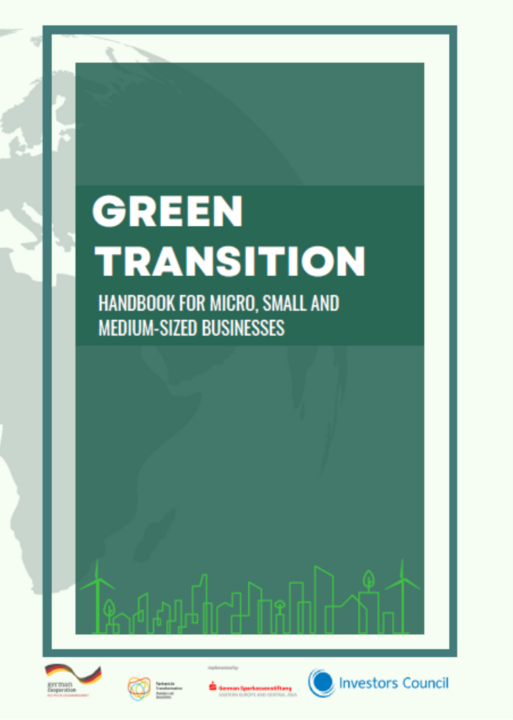
How can small businesses become greener while remaining competitive? The Green Economy Transition Handbook, developed jointly by the German Sparkassenstiftung for International Cooperation (DSIK), Georgia Office and the EBRD Investors Council Secretariat of Georgia, provides practical guidance for micro, small and medium-sized enterprises (MSMEs) on their path towards more sustainable business practices.
The handbook translates the concept of green transition into practical approaches that businesses can apply in their day-to-day operations. It focuses on efficient use of energy, water and raw materials, waste reduction, resource-efficient and cleaner production, and the gradual development of circular business models. Readers understand that sustainability is not only an environmental responsibility, but can also make good business sense. More efficient use of resources can reduce costs and improve productivity, while sustainable business practices can strengthen competitiveness, support regulatory compliance and create opportunities for new markets.
Green transition does not have to start with major investments - every step counts. The handbook encourages MSMEs to start by assessing their current practices, identifying realistic improvements and monitoring progress. Practical tools and templates for developing a Green Transition Action Plan help to structure the process.
The handbook also highlights the link between sustainable business practices and access to finance, showing how a stronger sustainability profile can improve opportunities for green financing and technical assistance.
Available in both Georgian and English, this handbook has been developed as an educational and informational resource. It is intended for anyone running a small business, planning to become a sustainable entrepreneur, or simply interested in learning more about the topic.
View online / download the Green Transition Handbook in English
View online / download the Green Transition Handbook in Georgian